
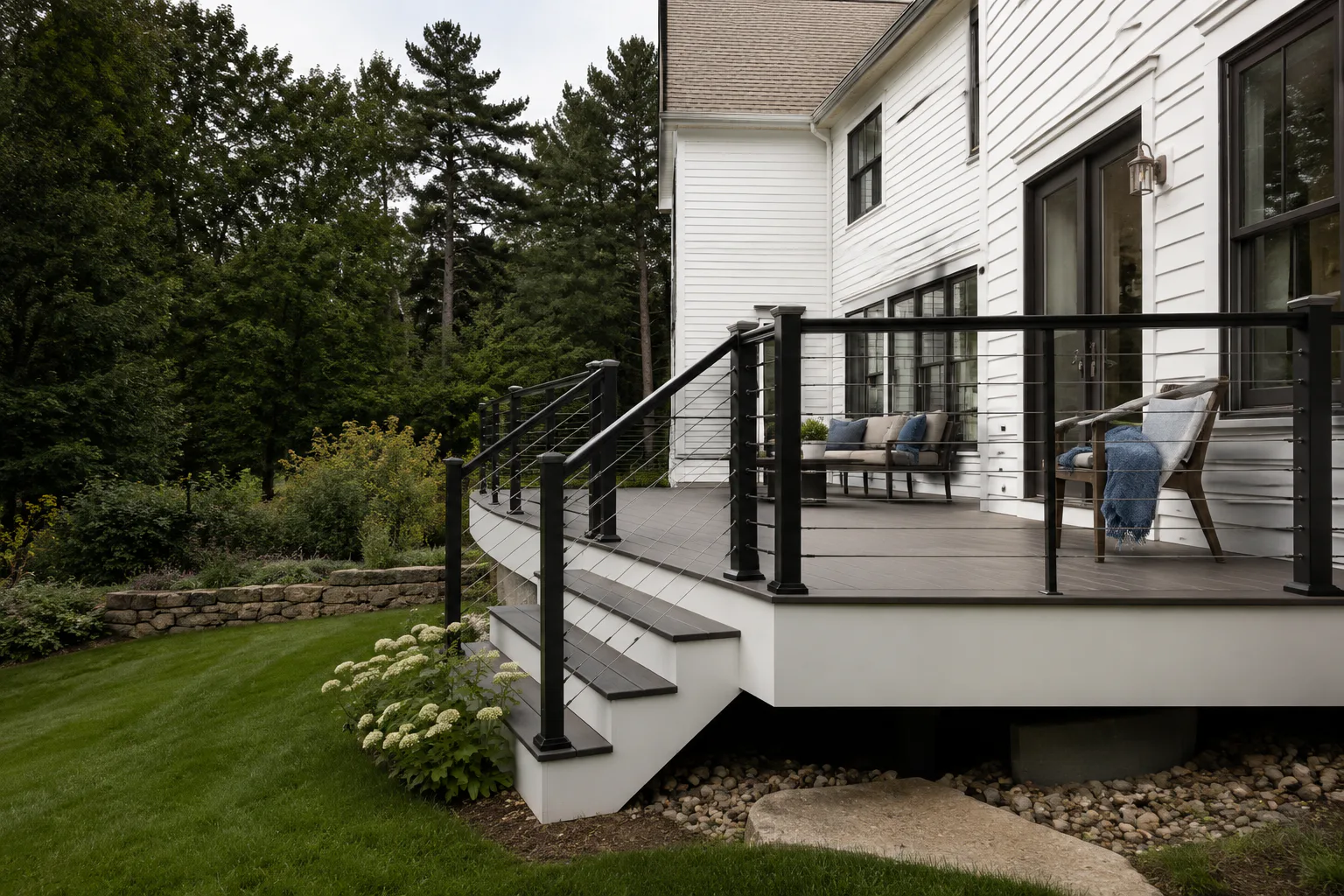
Deck cost is driven by the amount and complexity of structure, demolition, height, stairs, railings, surface system, site access, and permit requirements. A price per square foot cannot describe those conditions reliably.
Which factors have the greatest effect on deck cost?
Larger areas require more structure and finish. Angles, picture framing, multiple levels, and integrated steps add material and labor.
Footings, posts, beams, bracing, ledger conditions, and elevated work affect the build before finish boards are counted.
Stairs add stringers, treads, landings, rails, and substantial finish work. Railing length and system choice can materially change the total.
Pressure-treated and composite boards carry different material, fastening, fascia, and detailing requirements.
Removing an old deck, disposing of material, protecting the yard, and moving supplies through a constrained property affect labor.
Municipal review, shoreland or zoning questions, utilities, grade, and the house connection can change preparation and scope.
How do repair, resurfacing, replacement, and new construction price differently?
A repair is defined by a localized cause. Resurfacing preserves a qualified frame but still includes demolition, structural corrections, and a complete finish system. Replacement includes demolition and a new assembly. New construction avoids demolition but may require new layout, excavation, and site planning.
The least expensive sound option depends on what can remain without transferring avoidable risk into the finished project.
What should a Southern Maine deck estimate make clear?
- What is being removed, retained, repaired, or rebuilt
- Footings, framing, hardware, flashing, and house-connection assumptions
- Decking product, fastening method, fascia, stairs, and railing system
- Demolition, disposal, site protection, and material access
- Permit responsibility and how concealed conditions will be handled
How can homeowners control budget without weakening the project?
Protect structure and connections first. Simplify shape, levels, board patterns, rail complexity, and finish upgrades before reducing work that controls safety, drainage, or service life. A straightforward rectangle with well-resolved stairs often delivers more usable value than a complicated footprint.
Common questions
Can a deck be accurately priced from square footage alone?
No. Square footage helps with quantities, but height, framing, footings, demolition, access, stairs, railings, materials, edge details, house connections, and permit requirements can change the project substantially.
Is composite decking always more expensive than wood?
Composite boards generally carry a higher initial material cost than pressure-treated decking. The full difference depends on the product line, fastening, fascia, rail system, framing preparation, and the maintenance period being compared.
Why do two deck estimates differ so much?
They may include different demolition, framing, hardware, flashing, stair, railing, finish, permit, disposal, or concealed-condition assumptions. Compare scope line by line before comparing totals.